
Guide to Low Voltage Licensing
Simplified Guide to CT Low Voltage Licensing
Since 1965 a statewide electrical license has been required to work or operate a business within Connecticut
- No reciprocity with any other states
- No residency restrictions
- No background check is required by the state
- Connecticut requires more education classroom hours than neighboring states
Different types of licenses are required dependent on the type of work you will be doing
- Contractor
- Limited by voltage and current
- Able to sell services to the public
- Able to hire journey person and apprentice
- Able to pull an electrical permit
- Continuing Education requirement is minimum of 4 hours annually
- See the DCP website for Fee Information
- Renews on September 30th every year
- Journeyperson
- Limited by voltage and current
- Can only work for a Connecticut licensed contractor
- Can only perform work for licensed category
- Cannot pull permits
- Continuing Education requirement is minimum of 4 hours annually
- See the DCP website for Fee Information
- Renews on September 30th every year
- Apprentice
- Must be registered with State Labor Department
- Cannot work on job alone without licensed supervision
- Must carry registration card on oneself when working in the field of his/her prospective license
- Record of training hours must be kept
- See the DCP website for Fee Information
- Renews July 1st every year
Types of Licenses
- T-1 Contractor
- Telecommunications, networking installation and service
- Able to sell services to public
- Must be registered with Connecticut Secretary of State
- Able to pull electrical permits
- Able to hire journeyperson and apprentice
- Must have been a T-2 journeyperson for 2 years
- T-2 Journeyperson
- Telecommunications, networking installation and service
- Cannot sell services to the public
- Not able to pull electrical permits
- Able to supervise apprentice
- Must have documented education in the field and at least 4 years of equivalent experience or 5 years of equivalent experience or training as a service technician to take T-2 test
- L-5 Contractor
- Low voltage contractor limited to alarm or signal work, audio and sound systems
- License limitations not to exceed 25 volts 5 amps
- Able to sell services as contractor to public
- Must be registered with Connecticut Secretary of State
- Able to pull electrical permits
- Able to hire journeypersons
- Must have been an L-6 Journeyperson for at least 2 years
- L-6 Journeyperson
- Low voltage limited journeyperson alarm or signal work, audio and sound systems
- License limitations 25 volts & 5 amps
- Cannot sell services to public
- Not able to pull electrical permits
- Able to supervise apprentice
- Must have completed required apprenticeship or 4 years of equivalent experience with documented education
- C-5 Contractor
- Low voltage contractor limited to low voltage systems and telephone interconnect
- License limitations not to exceed 48 volts 8 amps
- Able to sell services as contractor to public
- Must be registered with Connecticut Secretary of State
- Able to pull electrical permits
- Able to hire journeypersons
- Must have been a C-6 Journeyperson for at least 2 years
- C-6 Journeyperson
- Low voltage journeyperson limited to low voltage systems and telephone interconnect
- License limitations not to exceed 48 volts 8 Amps
- Cannot sell services to public
- Not able to pull electrical permits
- Able to supervise apprentice
- Must have completed required apprenticeship or 4 years of equivalent experience with documented education
- Education Requirements T-2
- T-Class license requires 288 hours of related classroom study consisting of:
- Basic Math
- Blueprint Reading
- Electrical Code 1
- Building Trade Safety (OSHA 30)
- Electrical Theory 1
- Basic Telecommunications
- Electrical Theory 2
- Telecom Cabling
- T-Class license requires 288 hours of related classroom study consisting of:
- Educational Requirements L-6
- L6 - Class license requires 288 hours of related classroom study consisting of:
- Basic Math
- Blueprint Reading
- Electrical Code 1
- Building Trade Safety (OSHA 30)
- Electrical Theory 1
- Basic Alarm Technology
- Electrical Theory 2
- Fire, access and CCTV systems
- Educational requirements C-6
- C-6 class license requires 360 hours of related classroom study consisting of:
- Basic math
- Blueprint reading
- Electrical code 1
- Building trade safety (OSHA 30)
- Electrical theory 1
- Basic alarm technology
- Electrical theory 2
- Fire, access and CCTV systems
- Basic telecommunications
- Telecom cabling
- L6 - Class license requires 288 hours of related classroom study consisting of:
Apprenticeship Information can be found on the Connecticut Department of Labor website here along with their FAQ Page.
Connecticut has an Apprentice Hiring Ratio as follows:
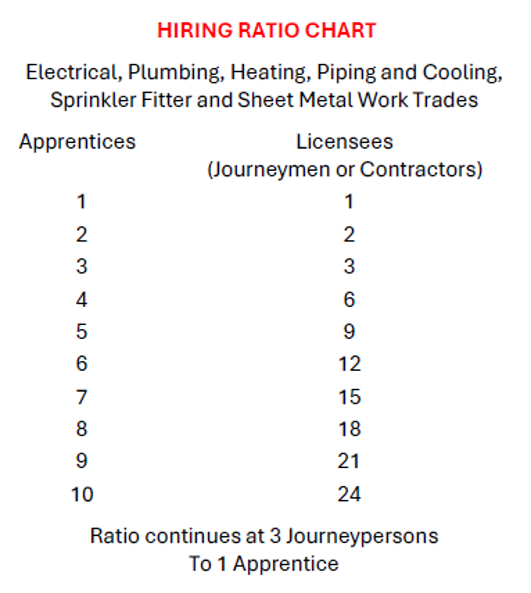
Once licensed, Connecticut requires 4 hours of Continuing Education each year through accredited schools for the class license as issued. Please see our CEU Offering page here.
- Class subject matter is determined by the Electrical Board based upon changes in sate and/or national codes
- Changes in technology and theory are interwoven with code changes
In 2026, Connecticut is moving to the 2023 National Electrical Code (NEC).
Here are Helpful Links:
Updated Spring 2026